
Extrusion Welding
Extrusion welding is used in the manufacture of thick-section fabrications, such as tanks and pipes, where it is necessary to produce large volume, homogeneous seams in a single pass.
THE PROCESS
Extrusion welding is a finishing technique where a bead of molten plastic is used to weld thermoplastic geomembrane materials. The quality of an extrusion weld is dependant on the skills of the welder operator.
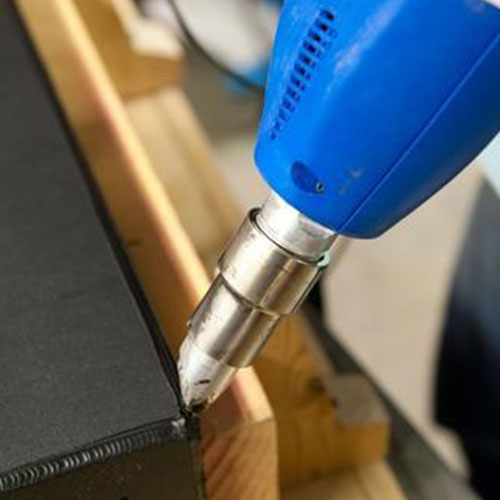
Extrusion welding machines use a heated barrel with a plasticating screw to deliver molten plastic to a specially shaped shoe. The shoe is shaped to make a bead of plastic suitable for the material type and thickness being welded. A hot air blower is attached to the extrusion welder to preheat the weld area. The welder uses its own weight to create the pressure required for welding and the operator steers the welder manually. Extrusion welders come in a number of sizes with different output rates.
Extrusion welding is a slow process and is normally limited to finishing work, cross seams, and tie-ins.
Extrusion welding is most commonly performed on HDPE sheet materials. Extrusion welding is also commonly used on Enviro Liner and Polypropylene. Extrusion welding of other thermoplastic materials is not common.
ADVANTAGES
The main advantage of extrusion welding is that it can achieve very high deposition rates of filler material into a joint, thus cutting down on cycle time. As compared to hot gas welding, which is a polymer welding process that could have many of the same applications, the time to completion for a weld is as much as 5-6x faster.
With proper parameters, the fusion areas of the weld will actually not be the weakest part of a given fabricated polymeric part.
Because many of the main welding parameters are preset on the machine, getting consistent high quality welds is possible.


Call Us Anytime: +27 84 444 5525
Send us an Email: info@thermoweld.co.za
Address: Unit 11 Austerville Factories, Maryhill Road, Jacobs